Luang Prabang Tour Packages from Malaysia
Luang Prabang has been called the most beautiful town in Southeast Asia — and unlike most superlatives attached to tourist destinations, this one holds up. UNESCO inscribed the city in 1995, citing the 'unique fusion of traditional Lao wooden architecture and European colonial buildings, set in a mountainous environment on the confluence of the Mekong and Nam Khan rivers.' Twenty-five years later, that fusion is still intact. The monks still walk in alms procession before dawn. The wooden shophouses are still occupied. The temples are still in daily use. The city occupies a narrow peninsula between two rivers: the Mekong to the north and west, the Nam Khan to the south. The tip of the peninsula, where the rivers meet, is the oldest part of the town — a cluster of temples, French colonial buildings and traditional Lao wooden houses that have remained essentially unchanged since the 1950s. Walking the length of the main street — Sisavangvong Road — takes less than twenty minutes, but most people take considerably longer because there is too much to look at. Wat Xieng Thong anchors the northern tip of the peninsula, beside the Mekong. Built by King Setthathirath in 1560 and never destroyed — while every other major temple in Laos was damaged or razed at least once — it is the oldest intact temple in the city and the finest example of Luang Prabang temple architecture. The sweeping curved roof descends in tiers almost to the ground level. The rear wall of the main hall is covered in the famous mosaic Tree of Life — Buddha's descent into the world represented as a spreading tree, set in coloured glass fragments on a black background. The royal funerary carriage house beside the main temple contains a gilded hearse 12 metres tall, used to transport royal remains to the cremation ground. The riverside gate faces the Mekong — early morning light through this gate is one of Luang Prabang's great photographs. The Royal Palace Museum — Haw Kham, the golden palace — was built in 1904 during the French protectorate as a residence for King Sisavang Vong. It was converted to a national museum in 1975 after the abolition of the monarchy. The throne room is preserved intact with its original gilded furniture, French colonial fittings, and Lao mural paintings of village life. The Phra Bang audience hall houses the sacred Phra Bang Buddha image, a Khmer bronze from the 9th century that is the most important religious object in Laos. Rooms display gifts from foreign heads of state including John F. Kennedy and the Soviet government. The palace forecourt contains the last remaining royal cars. Mount Phousi rises 100 metres above the peninsula from its exact centre. The name translates as 'sacred hill.' A stupa — That Chomsi — sits at the summit, visible from all directions across the city. The climb takes fifteen minutes via 328 stone steps. The view from the top encompasses the entire Luang Prabang basin: the Mekong curving through the valley, the Nam Khan joining it at the peninsula tip, the temple roofs, the French villas, and the mountains rising in all directions. At sunset, most of Luang Prabang makes this climb. Kuang Si Waterfall, 29 kilometres south of town, is the city's essential half-day excursion. Three tiers of travertine cascades drop through jungle into natural pools in a colour that has to be seen to be believed — a turquoise-blue so vivid it looks artificially lit, produced by the high calcium carbonate content of the water. The main cascade drops 50 metres. The lower pools are suitable for swimming. The Free the Bears sanctuary at the base houses rescued Asiatic black bears. Go before 09:30 to beat the groups. Every Luang Prabang package from Dhesu arrives via the Laos-China high-speed railway from Vientiane — a two-hour journey through karst mountains that is the most enjoyable train ride in mainland Southeast Asia. All packages are privately arranged with a licensed English-speaking guide. Halal meals can be arranged on request throughout the itinerary.
1 package available.
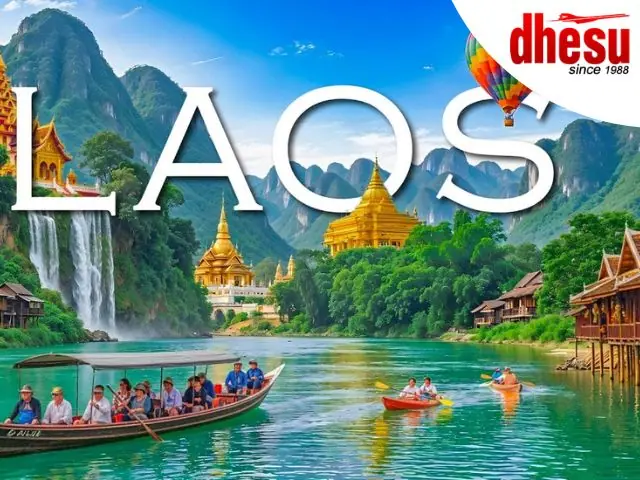
4 Days Sacred Laos | Vientiane & Luang Prabang by Train
- Pha That Luang — Laos's Sacred Golden Stupa
- UNESCO World Heritage Luang Prabang Old Town
- Kuang Si Waterfall & Turquoise Natural Pools
- First-Class High-Speed Train between Cities
- Wat Xieng Thong & Mount Phousi Sunset
Plan Your Laos Journey
Golden stupas, turquoise waterfalls, and the quietest corner of Southeast Asia. Tell us when you want to go.
Level 2 & 3, Wisma Dhesu, No. 5, Jalan Bangsar Utama 3, 59000 Kuala Lumpur, Malaysia