Vientiane Tour Packages from Malaysia
Vientiane is Southeast Asia's most underestimated capital — a riverside city of golden stupas, French colonial boulevards and Buddhist temples that move at a pace entirely their own. Where Bangkok has noise and Phnom Penh has energy and Hanoi has urgency, Vientiane has something quieter and harder to describe: a Buddhist calm that has settled into the architecture, the streets, and the people who live in them. The city sits on a broad bend of the Mekong River, facing Thailand across the water. The riverside promenade — Fa Ngum Road — is where Vientiane comes to walk in the evenings, when the sun drops behind the hills on the Thai side and the river goes copper and the street food vendors set up along the banks. It is one of the most relaxed evening scenes in Southeast Asia. Four landmarks define a proper visit to Vientiane, and all four can be covered meaningfully in a single afternoon. Pha That Luang — the Great Stupa — is the most important Buddhist monument in Laos and the symbol that appears on the national seal. A gold-covered stupa 45 metres tall, it stands on the site of a 3rd-century Khmer temple and was founded in its current form by King Setthathirath in 1566. The stupa represents Mount Meru, the centre of the Buddhist universe. The surrounding cloister contains 30 smaller stupas, each representing a tenet of Buddhist law. In November, the That Luang Festival — the largest Buddhist celebration in Laos — fills the grounds with monks, pilgrims and golden lanterns. Wat Si Saket, built in 1818, is the oldest wat in Vientiane to survive intact. The cloister walls contain niches holding 6,840 miniature Buddha images in silver, bronze and stone — some centuries old, some placed here in the last decade. The main hall holds a further 2,052 images. Walking the cloister takes time. Each image is slightly different and the accumulation of devotion the space represents is genuinely moving. Haw Phra Kaew was built in 1565 by King Setthathirath to house the Emerald Buddha — a sacred jade image now kept in Bangkok's Wat Phra Kaew after it was taken by the Siamese in 1779. The original temple was destroyed in 1828 and rebuilt in the 1930s as a national museum of Lao Buddhist art. The current collection includes lacquered thrones, gilded wooden screens, bronze and stone Buddha images, and 18th-century religious manuscripts. Patuxai — the Victory Gate — was built between 1957 and 1968, funded partly by American foreign aid intended for airport construction. The architect used the cement for a monument modelled on the Arc de Triomphe but decorated with traditional Lao Buddhist and Hindu motifs: apsaras, garuda, and naga in place of French classical reliefs. The interior is a maze of souvenir stalls and shrine rooms; the roof terrace gives the best views of Vientiane's broad, largely flat cityscape. Every Laos package from Dhesu that visits Vientiane includes all four sites with a licensed English-speaking guide. Halal meal arrangements are available at no extra cost — Masjid Al-Azhar is located in Vientiane and can be included in the itinerary on request. All packages are privately arranged with flexible departure dates.
1 package available.
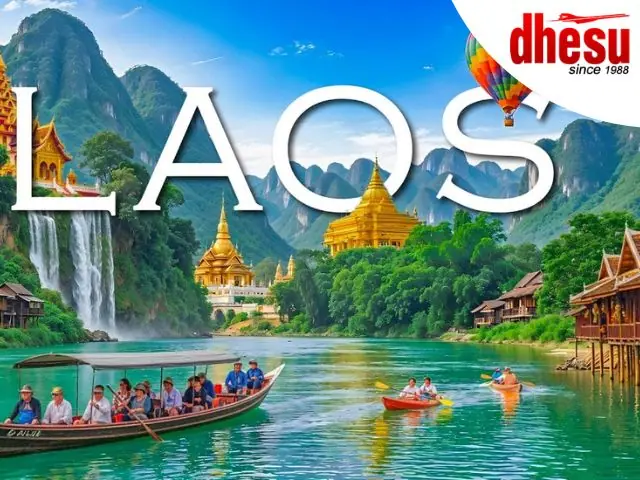
4 Days Sacred Laos | Vientiane & Luang Prabang by Train
- Pha That Luang — Laos's Sacred Golden Stupa
- UNESCO World Heritage Luang Prabang Old Town
- Kuang Si Waterfall & Turquoise Natural Pools
- First-Class High-Speed Train between Cities
- Wat Xieng Thong & Mount Phousi Sunset
Plan Your Laos Journey
Golden stupas, turquoise waterfalls, and the quietest corner of Southeast Asia. Tell us when you want to go.
Level 2 & 3, Wisma Dhesu, No. 5, Jalan Bangsar Utama 3, 59000 Kuala Lumpur, Malaysia